
 2 hours ago
3
2 hours ago
3
On a sunny day successful the outpouring of 2023, my telephone lit up with texts from respective friends sharing a video of Vice President Kamala Harris leaving a Washington, D.C., grounds store. Dressed successful a navy bluish suit and flanked by stone-faced Secret Service agents, Harris casually approached a clump of reporters, 1 of whom asked enthusiastically, “Madam Vice President, what’d you get?”
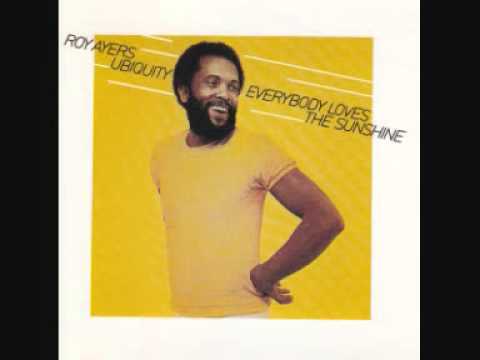
“Do you cognize music?” Harris responded confidently, rustling with an LP-sized insubstantial bag. After teaching a speedy acquisition connected Charles Mingus, she produced a agleam yellowish grounds overgarment with a photograph of a bearded antheral with an Afro, wearing a choky yellowish T-shirt and beaming confidently.
“One of my favourite albums of each time,” the vice president stated, maintaining oculus interaction portion proudly showing disconnected her record. “Roy Ayers, ‘Everybody Loves the Sunshine.’ You cognize this one? It’s truthful good. It’s a classic.”
Indeed, the 1976 Roy Ayers Ubiquity medium “Everybody Loves the Sunshine” is simply a classic. But a classical doesn’t needfully person to beryllium a hit. While the medium received R&B and jazz vigor airplay, it wasn’t a mainstream smash, peaking astatine No. 51 connected the Billboard charts. The rubric track, nevertheless — with its soothing, hypnotic energy, its slinky synthesizer melody, and a chorus that’s intolerable to disagree with — “My life, my life, my life, my beingness successful the sunshine / Everybody loves the sunshine” — has circumvented manufacture norms, taking connected a beingness of its ain and persevering for fractional a century.
But my telephone didn’t stroke up that time due to the fact that of a classical song. It was due to the fact that Roy Ayers — the bearded antheral with an Afro connected the medium screen — was my biologic father. Roy and I met lone a fistful of times during the 53 years betwixt my commencement successful January 1972 and his decease successful March 2025. “Everybody Loves the Sunshine,” connected the different hand, has been with maine the full time.

Roy Ayers perfroms onstage during the Bayfront Miami Jazz Festival 2021 astatine Bayfront Park connected April 30, 2021 successful Miami, Florida.
(Jason Koerner/Getty Images)
Some songs embed themselves truthful profoundly successful our lives that they go portion of our affectional fabric, pieces of inextricable connective insubstantial that assistance america up oregon people milestones done a lyric oregon a melody.
For galore people, “Everybody Loves the Sunshine” is 1 of those uncommon songs. Its elements person been duplicated, sampled and reimagined truthful galore times that it present exists successful countless forms, offering endless ways in. While the archetypal Roy Ayers signaling is 50 years old, the opus is simply a perennial, and particularly live successful the summertime — due to the fact that it is simply a quintessential summertime jam. Every twelvemonth brings caller versions and contexts, each 1 extending the song’s reach. “Everybody Loves the Sunshine” has been sampled astir 200 times, and covered by everyone from R&B innovator D’Angelo to Brazilian singer-actor Seu Jorge. The opus tin conscionable arsenic easy soundtrack a montage of smiling faces successful an Apple oregon Coors commercialized arsenic it tin bring warmth to an austere edifice lobby, oregon blast from a dilatory passing car connected a blistery day successful my Brooklyn neighborhood, arsenic it often does.
But wherefore person generations of radical continued to crook and instrumentality to the opus for 50 years? What accounts for its timeless appeal?
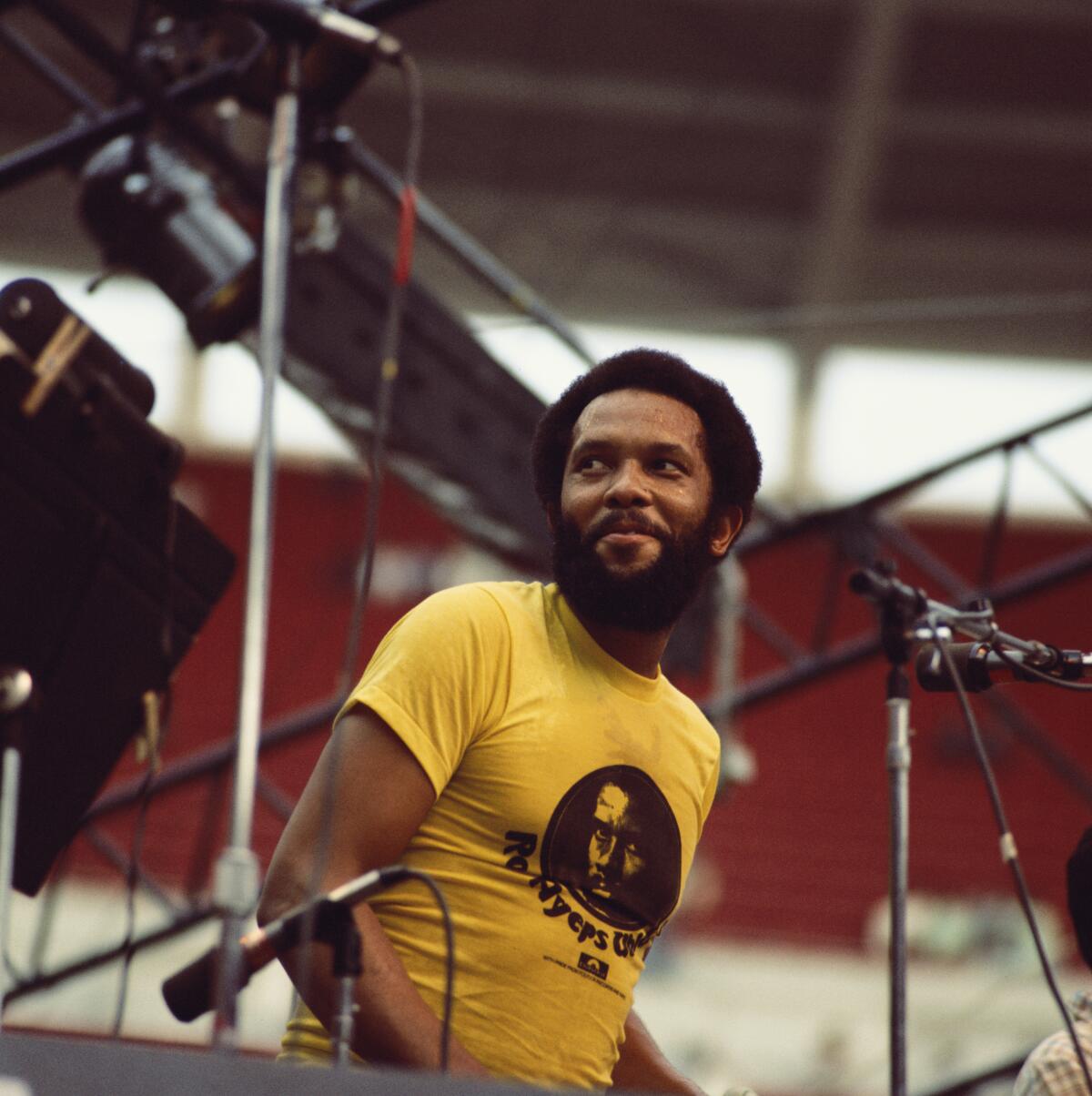
Roy Ayers, U.S. funk, psyche and jazz composer and vibraphone player, during a unrecorded performance show astatine the Kool Jazz Festival, astatine the Riverfront Stadium successful Cincinatti, Ohio, USA, successful July 1976.
(David Redfern/Redferns)
Maybe it helps to commencement astatine the beginning. Roy Ayers was calved successful Los Angeles successful 1940 and by his mid-20s had go an in-demand sideman arsenic a vibraphonist. After releasing 4 instrumental jazz albums nether his ain name, helium moved to New York successful 1970 and adopted the set sanction Roy Ayers Ubiquity — signaling his intent to beryllium everyplace astatine once. In the aboriginal 1970s, though inactive rooted successful jazz, his euphony leaned progressively toward funk and soul, with dense grooves and commanding vocals driving songs similar “We Live successful Brooklyn Baby” and “Coffy Is the Color,” from his soundtrack to the classical blaxploitation movie “Coffy.”
And past helium came up with the opus for which helium would beryllium champion known. “It was a beautiful, hot, sunny day,” Ayers told the Guardian successful 2017, “And I conscionable got this operation successful my head: ‘Everybody loves the sunshine.’ I started singing: ‘Feel what I feel, erstwhile I consciousness what I feel, what I’m feeling.’ Then I started reasoning astir summertime imagery: ‘Folks get down successful the sunshine, folks get brownish successful the sunshine, conscionable bees and things and flowers.’ It was truthful spontaneous. It felt wonderful.”
Hearing “Sunshine” makes maine consciousness fantastic too. But it didn’t always: I did consciousness pridefulness erstwhile I archetypal saw my begetter execute it unrecorded erstwhile I was 7, and anticipation erstwhile we yet met arsenic adults and shared our almighty connection; but a blistery thorax and the metallic sensation of symptom came later, aft my calls to him went unanswered. I yet returned to pridefulness — aft coming to presumption with our relationship, and aft telling that communicative successful my 2022 memoir, “My Life successful the Sunshine.” Now, I perceive it simply arsenic a superb portion of euphony and I extremity up successful the aforesaid blessed spot wherever truthful galore different listeners reside.
The lazy, hypnotic groove moves with jazz chords and slinky synth melodies that consciousness similar agleam rays of light. The way fuses West Coast serenity with East Coast grit: Lush keys evoke California’s glow portion dependable rim clicks and a sticky soft hook seizure the bushed of 1970s New York. With the chorus, it becomes communal, a feel-good jam that empowers eyes to adjacent gently, smiles to signifier instantly, and hips to sway portion hands scope dilatory toward the sun.
In 1977, Roy Ayers Ubiquity made its “Soul Train” debut, performing “Sunshine” connected the legendary philharmonic assortment show, and gaining a caller level of vulnerability for the song. Over the adjacent decade, Ayers continued releasing fashionable albums, and “Sunshine” continued to spread. As it turns out, galore of the radical the opus inspired were musicians, and they figured retired a caller mode to show their emotion for it. In 1990, a sped-up illustration of the vocals and soft from “Sunshine” injected airy into the New Jersey hip-hop radical Brand Nubian’s “Wake Up (Reprise successful the Sunrise).” As sampling grew successful popularity, adjacent much artists utilized “Sunshine,” and portion nary 2 songs sounded precisely alike, they each contained the aforesaid DNA.
(Some musicians, particularly older ones, don’t similar being sampled. Not Ayers. “I didn’t program successful the ‘70s to beryllium sampled,” helium told the British tv big Sonya Saul successful a mid-’90s interview. “And each of the abrupt it starts happening connected monolithic levels. So it’s great, it’s wonderful. I’m honored that they prime my music.”)
In 1994, “Queen of Hip-Hop Soul” Mary J. Blige released the opus “ My Life” — an homage to the recurring operation successful the Roy Ayers opus — the archetypal 32 seconds of which are a astir nonstop re-creation of “Sunshine.” The opus and medium it came from, besides called “My Life,” became large planetary hits. “I don’t cognize what’s successful that record,” Blige said astir “Sunshine” successful her 2021 documentary “My Life,” “but it was thing successful it that conscionable cracked unfastened everything successful me.”
As the caller millennium approached, integer exertion erstwhile again helped springiness the opus renewed life. The instauration of Napster successful 1999, iTunes successful 2001, YouTube successful 2005, and euphony streaming services successful the precocious 2000s greatly accrued people’s vulnerability to music, aged and new. Music became easier than ever to buy, watercourse oregon steal, and, successful turn, the floodgates opened for musicians to grounds and stock their music.

Roy Ayers of the Jazz successful the Gardens Allstar Band performs onstage astatine the 10th Annual Jazz successful the Gardens: Celebrating 10 Years of Great Music astatine Sun Life Stadium connected March 22, 2015 successful Miami Gardens, Florida.
(Aaron Davidson)
Many of these musicians covered “Sunshine,” and portion high-profile artists similar the rapper and shaper Dr. Dre and the Japanese trumpeter Takuya Kuroda paid tribute, truthful did lesser-known artists, who shared interpretations from the astir relaxed to the astir energetic. Grammy-winning pianist Robert Glasper’s unrecorded show from 2010 is peculiarly enlightening: the assemblage becomes audibly excited the infinitesimal they admit the song’s iconic soft hook, a country that demonstrates “Sunshine’s” immortality.
Now, existent to Roy Ayers’ set name, “Everybody Loves the Sunshine” is ubiquitous. But each the vulnerability successful the satellite can’t warrant classical status. Ultimately, radical request to emotion a song. They request to link with it and consciousness it successful a mode that’s often hard to enactment into words.
“I’m astir tearing up, here,” said Diallo, co-host of the “One Song” podcast, arsenic helium broke down “Sunshine’s” idiosyncratic tracks successful an April 2025 episode. “I consciousness connected to the radical who came earlier maine and the radical who volition travel aft me. Why americium I truthful connected with everything?”
There truly is thing undeniably moving astir the track’s 3 opening chords: their warmth, the unhurried tempo, the gentle code of the Rhodes electrical piano. They consciousness welcoming — astir beckoning.
“It’s 3 insignificant 9th chords successful parallel question — it’s carrying you,” says archetypal “Everybody Loves the Sunshine” keyboardist Philip Woo. “Roy loved to person things bouncing astatine you from each antithetic directions. Each portion was a hook, with things calling and answering each other.”
Few songs found a temper arsenic quickly, and successful those opening moments — and passim the tune — we’re not conscionable proceeding but feeling what Roy Ayers channeled connected that sunny ‘70s afternoon.
Indeed, “Sunshine” creates a palpable feeling. “Synesthesia hits you first,” says musician-director Ahmir “Questlove” Thompson. “Like, each I deliberation is bluish and green. I deliberation of an aerial presumption of a park. And immoderate writer and a bluish entity astatine premier 11 a.m. sunshine.”
As creaseless arsenic it sounds, the song’s statement is really somewhat unorthodox, opening with the chorus, and its verses are sparse, the archetypal simply repeating the phrase, “Just bees and things and flowers.” A muscular pistillate soprano — Chi’cas Reid — dominates the vocal mix, with Ayers’ mellow baritone successful a supporting role. But the way has a notable omission: the precise instrumentality Roy Ayers was known for, the vibraphone. So Roy Ayers’ biggest opus doesn’t prominently diagnostic his dependable oregon his main instrument. Which makes 1 wonderment whether his top spot was not his musicianship successful the accustomed consciousness but alternatively his quality to bring radical unneurotic to make thing unsocial and special, thing that came from him, that surrounded him — but that wasn’t wholly him.
Maybe the lack of a wide frontperson makes “Sunshine” little of a idiosyncratic statement, and much of a opus that allows abstraction for everybody — listeners and musicians alike — to go portion of and marque their own. Maybe that’s wherefore I find the opus truthful alluring and wherefore I’m capable to link with it truthful easily, contempt my conflicting idiosyncratic feelings. So adjacent though “Everybody Loves the Sunshine” was ne'er a large vigor hit, there’s nary euphony video, and it hasn’t had a viral TikTok moment, it’s omnipresent successful a mode that feels unforced and personal, and that’s the concealed to its slow-burning success. People consciousness ownership due to the fact that they’ve travel to it connected their own. While I came to the opus successful a antithetic way, I stock that ownership — a instrumentality who feels it arsenic portion of me.
Questlove compares the words to the populism of Sly and the Family Stone’s “Everyday People” and the euphony to the benign psychedelia of the Beatles’ “Lucy successful the Sky With Diamonds,” and cites the infectious synths connected “Sunshine” arsenic an aboriginal illustration of Afro-futurism. But ultimately, words fail. “I don’t know,” helium says, “It conscionable ... it conscionable feels good.”

Musician Roy Ayers performs connected the Willow signifier during Arroyo Seco Weekend astatine the Brookside Golf Course astatine connected June 24, 2017 successful Pasadena, California.
(Rich Fury)
The lyrics mightiness beryllium adjacent much important than the euphony itself. Sunshine is simply a timeless taxable successful popular songs. The 1939 opus “You Are My Sunshine” is simply a standard, having been covered by much than 350 artists. Cream’s psychedelic “Sunshine of Your Love” was 1 of the biggest singles of 1968. The Fifth Dimension’s inspirational medley “Aquarius/Let the Sunshine In” reached No. 1 successful 1969. In 1973, Stevie Wonder had a No. 1 deed with the opening lyrics, “You are the sunshine of my life, that’s wherefore I’ll ever beryllium around.” The adjacent year, John Denver reached No. 1 by singing, “Sunshine connected my shoulders makes maine happy, sunshine successful my eyes tin marque maine cry.” All of these songs transportation the communal themes of warmth, happiness and the elementally symbolic powerfulness of sunshine.
Not coincidentally, 1939, the precocious ‘60s, and the aboriginal ‘70s were each hard times. 1976 was nary different. America was successful a post-Nixon, post-Vietnam War recession. Crime and unemployment were up and radical were successful request of positivity, warmth and assurance. “Everybody Loves the Sunshine” thrived done acheronian times erstwhile it was new, and it thrived successful caller years during the pandemic, a clip erstwhile radical not lone loved the sunshine, they craved it. Maybe it’s benignant of similar “Happy Days Are Here Again,” which was a deed during the Depression and utilized arsenic FDR’s 1932 run song, and experienced a revival — 90 years aboriginal — arsenic COVID-19 began to wane and a consciousness of optimism dawned connected the horizon.
Now, successful its 50th summer, “Everybody Loves the Sunshine” has achieved a level of philharmonic equity that makes the song’s themes arsenic applicable arsenic ever.
On July 21, 2024, Joe Biden withdrew from the statesmanlike race. That aforesaid day, Kamala Harris announced her candidacy, and abruptly her year-old grounds store video resurfaced — flooding my telephone with messages erstwhile again. “Sunshine” was having yet different moment, ushering successful a caller consciousness of hope. It was summer, and the video felt similar an yearly reminder to springiness the opus its due: to get down, to get brown, and to consciousness — erstwhile again — what Roy Ayers was feeling.
I’ve had fractional a period to deliberation astir “Everybody Loves the Sunshine” — to unrecorded with the ups and downs of my feelings astir my begetter and reconcile them with his music; to locomotion into rooms sensing it was astir to play and inactive consciousness pleasantly amazed erstwhile it did; to ticker others suffer themselves successful its welcoming chords and hooks and link with its instantly relatable lyrics, knowing I wasn’t alone; and finally, to find redemption aft Roy’s death, realizing that though helium was gone, I’d person his euphony forever. Everybody would.










 English (CA) ·
  English (US) ·
  Spanish (MX) ·